
It's that rather over-commercialized St. Valentine's day here. Now I'll be first to admit I am the guy who still tries to give his wife a flower and romantic dinner and card, not so much because I am victim of advertising, but because I like an opportunity to spoil her, and she still has to cope with me in the other 364 non-Valentine days. And trust me, that's no holiday... anyway, I'm neck deep in this book, which, duh, has a romance in a Fantasy. So I thought... love seems to be the used as a metaphor (surely it's mostly a met-a-two?) and we could have a metaphor challenge here. Someone sent me 99 of these...
"No cord or cable can draw so forcibly, or bind so fast, as love can
do with only a single thread."
(Robert Burton, The Anatomy of Melancholy, 1621)
Your turn :-)
Monday, February 14, 2011

Sunday, February 13, 2011
The Week in the News
Sorry I'm a little late getting today's post up. I didn't write it yesterday because I wanted to see the latest headlines before deciding on the day's topics.
First, I want to brag on my hometown. Another reason I didn't write the blog yesterday was because I spent most of the day at our new library's grand opening. In this time of libraries closing or losing funding, our community has rallied around the library and build a wonderful new facility. Hopefully, I'll have some photos next weekend to post. What is really great about the new building is the fact our teens are invested in it. Several years ago when the architects asked for input from the community, half a dozen different groups got together and drew up their ideal floor plans. The teens' plan is the one that was chosen. That invests them in the library and their support was clear yesterday.
Any way, on to what's happening around the publishing world.
I'm going to keep with local news for a moment. Earlier this week, Amazon sent out notices to its employees at the distribution center near DFW Airport that they would be shutting down the center. Why? Because the state comptroller wants to collect millions of dollars in taxes and penalties it says Amazon owes. Sorry, this is a distribution center. A center that employs a number of people. A center that was going to expand and hire up to another 1,000 workers.
Muddying the waters even more, Gov. Rick Perry has publicly announced he is firmly against the action taken by the comptroller and is going to do all he can to keep the distribution center here. The next month is going to be an interesting battle of wills between the governor, the comptroller and, quite possibly, the state legislature to see who blinks first. My take -- unless the comptroller can prove the distribution center is actually a sales center, Amazon will be asked to stay. But at what cost? What sort of concessions will the state have to roll out to "apologize" for an ill-timed, if not ill-conceived, move by the comptroller?
The New York Times revealed its best sellers list this week and, for the first time, e-books were included. I haven't had time to sit down and really study it, but the one thing that jumps out is the fact that the top five titles on the combined print & e-book list are the same as the top five titles on the e-book list. Two titles flip-flop positions, but that is the only difference. The same can't be said for the non-fiction top five. Does this mean there are more fiction e-titles being purchased than non-fiction? Probably. What will be interesting is to see the reaction of traditional publishers when e-books brought out by authors digitally publishing their works on their own or by small digital presses break into the top ten.
Finally, no blog about the industry can close without mentioning the latest news about Borders. I don't think it surprises anyone the speculation is now rife over whether or not Borders will be filing for bankruptcy this week. Borders hasn't publicly confirmed this. However, it doesn't take much searching online to find posts from employees or people "in the know" who say it's a done deal. Now they are only waiting to find out if their stores will be saved.
What is of concern to me -- beyond the worry for my friends and acquaintances who work for Borders -- is how this will affect the publishing industry as a whole. Borders owes publishers and non-publishing vendors thousands of dollars for stock already in stores. (This figure may -- and probably is -- be substantially larger. We won't know until the bankruptcy papers are filed.) A number of publishers have already ceased shipments to Borders. It's a move I can understand. Publishers are, on the whole, struggling themselves. They can't afford to ship product without guarantee of payment. On the other hand, how can a bookstore make money if it doesn't have books to sell? It really is one of those "damned if you do, damned if you don't" situations.
But there is another factor to be considered. Ingram continues to ship books to Borders when so many of the publishers have stopped. Ingram is the distribution outlet for a number of publishers, many of them small to mid-sized publishers who don't have their own distribution arm. What the immediate and long-term impact this will have on these publishers, as well as Ingram, when Borders files for bankruptcy remains to be seen. But it is worrisome.
I hope Borders can find a way to come through this without completely going under. I'm not sure it can. What we have to prepare for is that this isn't the last of the upheavals that will happen in publishing over the next few years. This is just the opening volley. So grab onto something and hold tight. Publishing will come through this, but it is going to be an interesting ride for awhile.
(Cross-posted to The Naked Truth)
First, I want to brag on my hometown. Another reason I didn't write the blog yesterday was because I spent most of the day at our new library's grand opening. In this time of libraries closing or losing funding, our community has rallied around the library and build a wonderful new facility. Hopefully, I'll have some photos next weekend to post. What is really great about the new building is the fact our teens are invested in it. Several years ago when the architects asked for input from the community, half a dozen different groups got together and drew up their ideal floor plans. The teens' plan is the one that was chosen. That invests them in the library and their support was clear yesterday.
Any way, on to what's happening around the publishing world.
I'm going to keep with local news for a moment. Earlier this week, Amazon sent out notices to its employees at the distribution center near DFW Airport that they would be shutting down the center. Why? Because the state comptroller wants to collect millions of dollars in taxes and penalties it says Amazon owes. Sorry, this is a distribution center. A center that employs a number of people. A center that was going to expand and hire up to another 1,000 workers.
Muddying the waters even more, Gov. Rick Perry has publicly announced he is firmly against the action taken by the comptroller and is going to do all he can to keep the distribution center here. The next month is going to be an interesting battle of wills between the governor, the comptroller and, quite possibly, the state legislature to see who blinks first. My take -- unless the comptroller can prove the distribution center is actually a sales center, Amazon will be asked to stay. But at what cost? What sort of concessions will the state have to roll out to "apologize" for an ill-timed, if not ill-conceived, move by the comptroller?
The New York Times revealed its best sellers list this week and, for the first time, e-books were included. I haven't had time to sit down and really study it, but the one thing that jumps out is the fact that the top five titles on the combined print & e-book list are the same as the top five titles on the e-book list. Two titles flip-flop positions, but that is the only difference. The same can't be said for the non-fiction top five. Does this mean there are more fiction e-titles being purchased than non-fiction? Probably. What will be interesting is to see the reaction of traditional publishers when e-books brought out by authors digitally publishing their works on their own or by small digital presses break into the top ten.
Finally, no blog about the industry can close without mentioning the latest news about Borders. I don't think it surprises anyone the speculation is now rife over whether or not Borders will be filing for bankruptcy this week. Borders hasn't publicly confirmed this. However, it doesn't take much searching online to find posts from employees or people "in the know" who say it's a done deal. Now they are only waiting to find out if their stores will be saved.
What is of concern to me -- beyond the worry for my friends and acquaintances who work for Borders -- is how this will affect the publishing industry as a whole. Borders owes publishers and non-publishing vendors thousands of dollars for stock already in stores. (This figure may -- and probably is -- be substantially larger. We won't know until the bankruptcy papers are filed.) A number of publishers have already ceased shipments to Borders. It's a move I can understand. Publishers are, on the whole, struggling themselves. They can't afford to ship product without guarantee of payment. On the other hand, how can a bookstore make money if it doesn't have books to sell? It really is one of those "damned if you do, damned if you don't" situations.
But there is another factor to be considered. Ingram continues to ship books to Borders when so many of the publishers have stopped. Ingram is the distribution outlet for a number of publishers, many of them small to mid-sized publishers who don't have their own distribution arm. What the immediate and long-term impact this will have on these publishers, as well as Ingram, when Borders files for bankruptcy remains to be seen. But it is worrisome.
I hope Borders can find a way to come through this without completely going under. I'm not sure it can. What we have to prepare for is that this isn't the last of the upheavals that will happen in publishing over the next few years. This is just the opening volley. So grab onto something and hold tight. Publishing will come through this, but it is going to be an interesting ride for awhile.
(Cross-posted to The Naked Truth)
Friday, February 11, 2011
Welcome to Yos!
 My first novel, The Calvanni, is an heroic fantasy adventure set on the world of Yos.
The book is no doubt heavily influenced by David Gemmell, my all time favourite writer.
To the left is a map of the continent of Kelas, where all the action in The Calvanni takes place.
On Yos all metal is magical. Weapons are crafted of exotic ceramics, the secrets handed down from master glassmith to apprentice for centuries. Razor sharp, but often brittle, the lanedd blades can be cast no longer than a long knife or calv. Calvanni means 'knife fighter'. On Yos there are no swords, and specialist pole arms called 'scythes' and spears are the weapons of choice in the field.
Control of magic is the ultimate basis for power. Since the fall of the Bulvuran Empire the Druids have monopolized power, outlawing the ancient practice of Sorcery, once the domain of the Bulvuran nobility.
Yos has twin suns that play havoc with the weather. Their regular eclipse causes Storm Season, when most of the wildlife - and the various sentient races - stay out of the cold and the vicious storms that follow. Any human unlucky enough to find themselves out in Storm Season has to contend with the Heat, a biological mechanism that can keep them alive - at a price.
The events in The Calvanni are set thirty years after the fall of the once vast Bulvuran Empire, when Kelas is divided into waring sardoms, and the ancient enemy of Man, the Eathal, plot their long-awaited revenge in the deep caverns of Maht.
My first foray into the world of Yos was a novella called Flight of the Phoenix, set at the fall of the Empire. Learning of the plot to destroy the Bulvuran Emperor and his family, the aging general Belin has to race through the night to save the life of the Empress Evylin and her newborn child. Always fearful of magic, Belin is confronted with powerful sorcery, facing an Eathal shapechanger in an epic battle that shakes the foundations of Yos itself.
The novella was published in 2003 in the Fantasy Readers Wanted - Apply Within anthology.
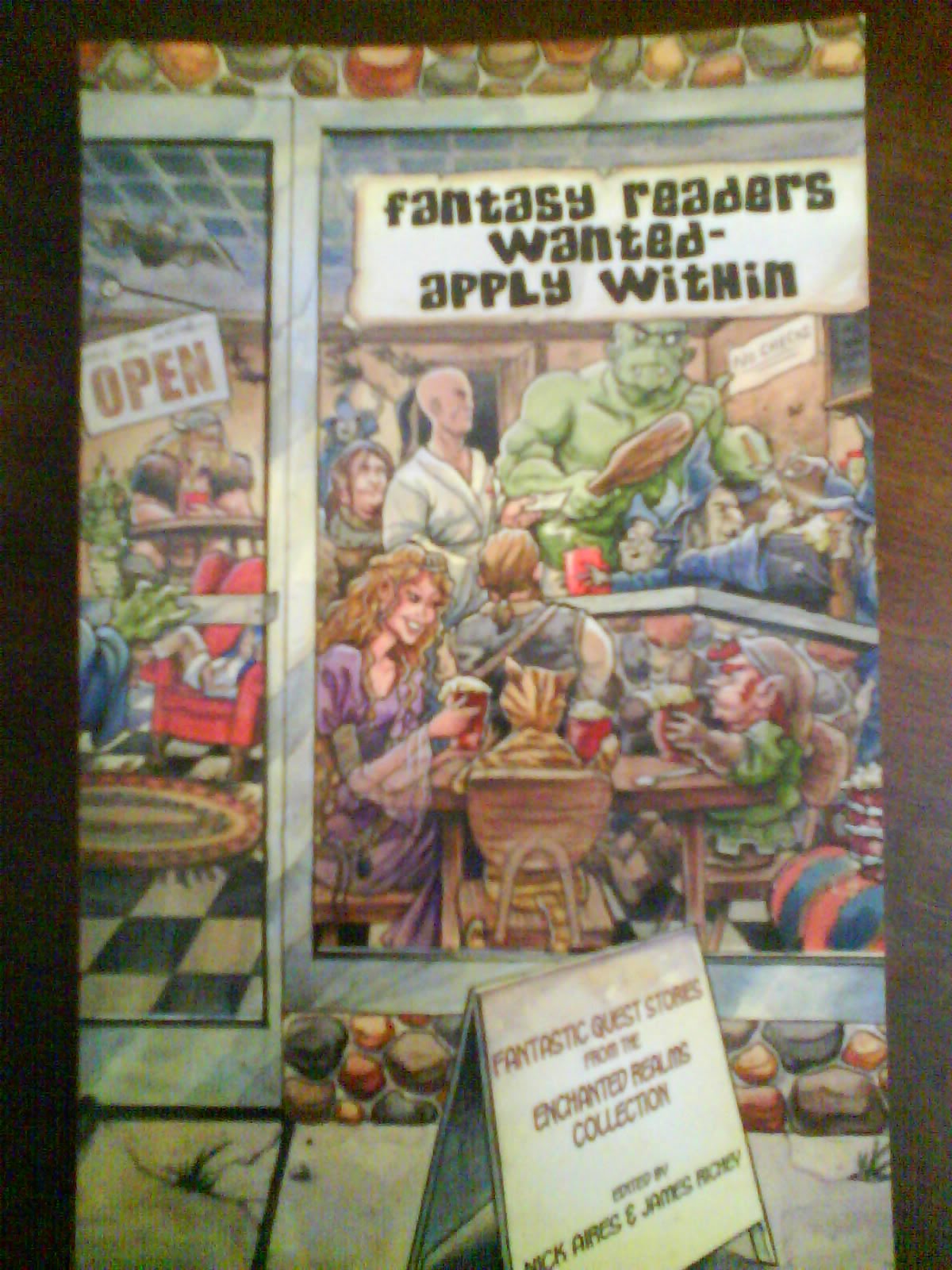
I am very excited to announce that Flight of the Phoenix will be republished by Naked Reader in electronic format (May/June)!
I have a signed copy of the Fantasy Readers Wanted - Apply Within anthology to give away (which has a poem by Neil Gaiman in it. No really.) to the first person to email me at "chrismcmahonAT
How many Temples of the Iris are there?

HINT: If you have not read The Calvanni, the answer is somewhere on my website.
Good hunting!
Thursday, February 10, 2011
How Much Description?
 Just for something different I decided to start a SF novel last week, this time without much more than the central concept and ideas for the two main characters. This is quite a departure for me as I usually plot things out well in advance and also spend a lot of time on backstory.
 The thing I noticed was that what I was writing was quite spare on description. This is probably partly because with this off-the-cuff style I was more focused on dialogue and character, but also because I think I tend to be less focused on description generally when I write SF.
This really got me thinking. So does that mean that I use too much description for my fantasy work? How much description is the right amount? Does my SF need to be shown only on Black & White TVs?:)
There are a couple of competing theories here. One is that you should deliberately use less description and let the reader fill in the blanks. The other is that you should attempt to really draw things out for the reader, make immersion in the world and the scenery a key feature for the story - like how Tolkien used his descriptions of the scenery as a major element of the experience of LoR, even to the extent some argue it is a character in its own right.
I guess as I inevitably go back to redraft these first chapters I will have to decide whether I need to put more description in to match the usual balance of my style, or whether I stick to the purity of the storytelling voice.
How do people decide how much description to use? I don't think I have really ever made a conscious choice about this until now. It is usually just part of what arrives when I imagine the scenes.
I do remember one comment from a reader of my mixed-genre novel Warriors of the Blessed Realms. They said that the fantasy worlds seemed more real than the contemporary sections (set in Brisbane). Maybe I have to work harder to envisage a completely new world? At the time I did not see any problem with this - after all the fantasy world was more real to me than this one:)
Let's Talk About Sex
Rowena's and Sarah's posts brought up some interesting points about gender, sex and culture - no, not those points - and started me thinking. Those who haven't already run screaming may wish to stay to find out what I'm thinking about.
See, there are a whole lot of misconceptions about the differences between human male and human female, from - at one extreme - there being no more difference than whether it's an innie or and outie, all the way through the spectrum to the toxic notion that one gender or the other isn't fully human. Being presented with either pile of bovine excrement hits my hot buttons so hard I start shredding before I've settled on a target, usually with the sarcasmometer pegged out and ready to explode.
Starting with the uber-basics: at conception, the successful sperm is carrying either an X chromosome or a Y chromosome (yes, this is a very large simplification and doesn't include things like XXY, triple X, chimerism and the like. I'm trying to keep it simple). Eggs are always X chromosome. If the sperm has an X chromosome, if nothing goes wrong that egg will grow into a girl. If the sperm has a Y chromosome, the egg grows into a boy.
Each chromosome type (X or Y) carries a whole bunch of information that gets used as something rather like the 'recipe' for boys (Y) or girls (X). It's not as simple as "snails and puppydog tails" or "sugar and spice and all things nice" - it's more like sensitivity to certain hormones (males are relatively less sensitive to changes in the level of estrogens and progesterones, where females are relatively less sensitive to changing testosterone levels), skeletal development (female hip bone structure is quite different from the male version, partly to accommodate the requirement that the female incubate the offspring for 9 - 10 months and partly to lower the center of balance so those big fleshy bumps higher up don't cause problems. No, that's not why those changes happened - they happened because the females with them survived to have kids with them). Sex organs are involved, of course - the aforementioned innies and outies plus all the supporting tackle, and - probably the most influential when it comes to sexual differentiation - brain structure and chemistry.
That's right. Male and female brains are structured differently, and their brain fluid contains a different chemical mix. Obviously it's not a simple either/or thing - it's more that there are two partially overlapping normal distributions, one male, one female. The overlap is where the most effeminate men and least feminine women can be found.
Here's where things get fun: it's a known fact that psychotropic drugs alter brain chemistry. That's why they're used - they're a kind of blunt instrument to temporarily correct maladjusted brain chemistry (yes, even the illegal drugs. It's complicated, so I'm not touching that particular aspect of drugs expect to say that I personally take several prescribed psychotropic drugs and I know people who've found that they don't want or need the illegal drugs once diagnosed and prescribed legal ones. Of course, the plural of anecdote is not data, nor is it knowledge). There's also a whole lot of evidence that non-psychotropic drugs do the same thing: if it can cross the blood-brain barrier, it can affect brain chemistry, and therefore mood and how people think.
Given that, it's simple logic that male thought processes are different than female thought processes. The different balance of estrogens, progesterones, and testosterones alone would be enough to explain that. Even without any cultural programming, you'd get differences.
It's also well-established fact - and taught as such in every teacher ed class I know about (mostly in Australia, about 20 years ago) - that male and female development rates are different. Girls usually learn language and social skills before boys, and boys usually learn math and spatial skills before girls. Again, it's well-established that an early differentiation usually leads to a much larger differentiation later, so it's not exactly surprising that males tend to show a much greater preference and ability with physical, spatial skill sets, where females tend more towards social and verbal skill sets.
Where does that translate to Rowena's observation that college-age young men are disinterested to hostile about whether movies and games misrepresent women, or young women being reluctant to raise any kind of concerns about how women are represented? I don't think it's systemic gender-based discrimination - it's more a function of the differences in thinking styles and the prevailing culture - which in Australia is strongly biased towards stoic acceptance, not whining or complaining, and 'making do'. And culture, as the saying goes, tends to change one funeral at a time.
To start with, at college age, young males haven't finished developing yet (neither have young females). They're still trying out techniques for dealing with the rest of the world, and hostile to anything not 'of the tribe' - which at that age is the same sex, similar age bracket, and similar interests. The opposite sex is undiscovered, unconquered, and possibly dangerous despite the exploratory forays not causing anything more than a temporary limpness. Males that age are also typically anxious to prove that they're adults, and to prove their masculinity (this is one of the reason teens and early twenties is such an obnoxious age). Young females do something similar, although there the emphasis is more on belonging and on being more equal than others. The teen-girl-collective is a terrifying thing, especially from the outside.
An evolutionary digression here: evolutionary psychology has got itself a bad name because of the very human tendency to wrap everything into stories (which itself is a function of the damn near universal pattern recognition ability - predators that were better able to distinguish easy prey from dangerous prey, other predators, or stuff they couldn't eat were more likely to survive and pass that ability to their offspring. Prey animals that were better able to recognize nutritious food and distinguish approaching predators from everything else were more likely to survive and pass the ability to their offspring. It doesn't take many generations for abilities that make surviving more likely to become damn near universal). Stories are effectively uber-patterns that make it much easier to pass on knowledge - which in turn makes the recipient more likely to survive and pass their abilities and stories on to their offspring.
The thing to remember about evolution of any type is that there's no "end goal". What survives and breeds is what's better suited to the environment of the time. Evolutionary psychology seems to be an attempt to understand cultural evolution as compared to physical evolution. Along the way, some interesting aspects of sexual differentiation emerged, and humans being human and intensely interested in sex - instantly hit popular consciousness. Which promptly got a lot of it bass ackwards, not least because the disseminators of the interesting stuff are scientifically illiterate.
Here's the uber-simplified version. Biologically speaking, absent major tech advances women have to carry the babies and then be primary caregiver for a long period of time (up to five years, depending on when and where). That means they're physically vulnerable at the same time as they're protecting the next generation. The physical differences that allow a woman to carry a pregnancy from a microscopic egg to quite a few pounds of baby also reduce strength and speed so that even without pregnancy or children, a woman can't outrun or overpower a man of similar size (and most men will be bigger, because women are also generally smaller than men). If she's pregnant or has a small child to carry with her? Forget it.
So... the females who survived and whose children survived were better than their fellow females at 1) making alliances with other females to share child-watching and predator-watching duties; 2) moving themselves up the female hierarchy so their children had a higher priority than the children of low-status females; and 3) being chosen by a high-status male (which earned them better protection). All of these things take - you guessed it - language and social skills. It doesn't take all that many generations in a dangerous and highly competitive environment (most of them, absent modern technology) before skills like this are the norm, and a female subculture that continuously develops and reinforces those skills has arisen.
Meanwhile, the males who survived and sired lots of offspring were often the biggest, strongest, and best hunters - because while it's possible to live entirely on gathered food, meat packs a much bigger nutritional punch. He who brings home the big steaks has the best fed children, who grow up to be the biggest and strongest and best hunters. The abilities that were advantageous in that situation included mono-focus (the old jokes about men not being able to talk and pee come to mind), spatial awareness, and physical coordination (the latter two sharing a domain space with - ta da! - math).
Big surprise, over generations the mental and physical differences between male and female got more pronounced, and the male and female subcultures moved further apart. Add on the overall culture that evolved around male-female interaction and the local circumstances, fast forward a few thousand generations, and you get where we are today.
In Western cultures there's some reintegration - especially with single-sex schools becoming less common - and traditionally male and female domains no longer exclusive - but the process is a long way from complete and it may never be complete. Those biological differences will always be there.
So, men and women are still very different, and male and female subcultures are still very different from each other, complete with massively different priorities. That's universal - although the rules for interaction between male and female subcultures vary hugely around the world.
Ultimately, men and women are still going to think differently, no matter how close the subcultures get. If we treat that as "discrimination", we're headed for trouble. And yes, being writers we should be using this knowledge. Unfortunately it hasn't found its way to the gatekeepers yet - gatekeepers are like all authorities: they generally belong to the older generation and haven't adjusted to more recent cultural evolution - even when they think they have.
So... we write it, and we stealth it. But if we want to please the ultimate consumer - readers - we need to know what they're seeing when they look at the world. If we can understand it as well, we're more likely to catch their interest and attention.
In short - get the sex right!

See, there are a whole lot of misconceptions about the differences between human male and human female, from - at one extreme - there being no more difference than whether it's an innie or and outie, all the way through the spectrum to the toxic notion that one gender or the other isn't fully human. Being presented with either pile of bovine excrement hits my hot buttons so hard I start shredding before I've settled on a target, usually with the sarcasmometer pegged out and ready to explode.
Starting with the uber-basics: at conception, the successful sperm is carrying either an X chromosome or a Y chromosome (yes, this is a very large simplification and doesn't include things like XXY, triple X, chimerism and the like. I'm trying to keep it simple). Eggs are always X chromosome. If the sperm has an X chromosome, if nothing goes wrong that egg will grow into a girl. If the sperm has a Y chromosome, the egg grows into a boy.
Each chromosome type (X or Y) carries a whole bunch of information that gets used as something rather like the 'recipe' for boys (Y) or girls (X). It's not as simple as "snails and puppydog tails" or "sugar and spice and all things nice" - it's more like sensitivity to certain hormones (males are relatively less sensitive to changes in the level of estrogens and progesterones, where females are relatively less sensitive to changing testosterone levels), skeletal development (female hip bone structure is quite different from the male version, partly to accommodate the requirement that the female incubate the offspring for 9 - 10 months and partly to lower the center of balance so those big fleshy bumps higher up don't cause problems. No, that's not why those changes happened - they happened because the females with them survived to have kids with them). Sex organs are involved, of course - the aforementioned innies and outies plus all the supporting tackle, and - probably the most influential when it comes to sexual differentiation - brain structure and chemistry.
That's right. Male and female brains are structured differently, and their brain fluid contains a different chemical mix. Obviously it's not a simple either/or thing - it's more that there are two partially overlapping normal distributions, one male, one female. The overlap is where the most effeminate men and least feminine women can be found.
Here's where things get fun: it's a known fact that psychotropic drugs alter brain chemistry. That's why they're used - they're a kind of blunt instrument to temporarily correct maladjusted brain chemistry (yes, even the illegal drugs. It's complicated, so I'm not touching that particular aspect of drugs expect to say that I personally take several prescribed psychotropic drugs and I know people who've found that they don't want or need the illegal drugs once diagnosed and prescribed legal ones. Of course, the plural of anecdote is not data, nor is it knowledge). There's also a whole lot of evidence that non-psychotropic drugs do the same thing: if it can cross the blood-brain barrier, it can affect brain chemistry, and therefore mood and how people think.
Given that, it's simple logic that male thought processes are different than female thought processes. The different balance of estrogens, progesterones, and testosterones alone would be enough to explain that. Even without any cultural programming, you'd get differences.
It's also well-established fact - and taught as such in every teacher ed class I know about (mostly in Australia, about 20 years ago) - that male and female development rates are different. Girls usually learn language and social skills before boys, and boys usually learn math and spatial skills before girls. Again, it's well-established that an early differentiation usually leads to a much larger differentiation later, so it's not exactly surprising that males tend to show a much greater preference and ability with physical, spatial skill sets, where females tend more towards social and verbal skill sets.
Where does that translate to Rowena's observation that college-age young men are disinterested to hostile about whether movies and games misrepresent women, or young women being reluctant to raise any kind of concerns about how women are represented? I don't think it's systemic gender-based discrimination - it's more a function of the differences in thinking styles and the prevailing culture - which in Australia is strongly biased towards stoic acceptance, not whining or complaining, and 'making do'. And culture, as the saying goes, tends to change one funeral at a time.
To start with, at college age, young males haven't finished developing yet (neither have young females). They're still trying out techniques for dealing with the rest of the world, and hostile to anything not 'of the tribe' - which at that age is the same sex, similar age bracket, and similar interests. The opposite sex is undiscovered, unconquered, and possibly dangerous despite the exploratory forays not causing anything more than a temporary limpness. Males that age are also typically anxious to prove that they're adults, and to prove their masculinity (this is one of the reason teens and early twenties is such an obnoxious age). Young females do something similar, although there the emphasis is more on belonging and on being more equal than others. The teen-girl-collective is a terrifying thing, especially from the outside.
An evolutionary digression here: evolutionary psychology has got itself a bad name because of the very human tendency to wrap everything into stories (which itself is a function of the damn near universal pattern recognition ability - predators that were better able to distinguish easy prey from dangerous prey, other predators, or stuff they couldn't eat were more likely to survive and pass that ability to their offspring. Prey animals that were better able to recognize nutritious food and distinguish approaching predators from everything else were more likely to survive and pass the ability to their offspring. It doesn't take many generations for abilities that make surviving more likely to become damn near universal). Stories are effectively uber-patterns that make it much easier to pass on knowledge - which in turn makes the recipient more likely to survive and pass their abilities and stories on to their offspring.
The thing to remember about evolution of any type is that there's no "end goal". What survives and breeds is what's better suited to the environment of the time. Evolutionary psychology seems to be an attempt to understand cultural evolution as compared to physical evolution. Along the way, some interesting aspects of sexual differentiation emerged, and humans being human and intensely interested in sex - instantly hit popular consciousness. Which promptly got a lot of it bass ackwards, not least because the disseminators of the interesting stuff are scientifically illiterate.
Here's the uber-simplified version. Biologically speaking, absent major tech advances women have to carry the babies and then be primary caregiver for a long period of time (up to five years, depending on when and where). That means they're physically vulnerable at the same time as they're protecting the next generation. The physical differences that allow a woman to carry a pregnancy from a microscopic egg to quite a few pounds of baby also reduce strength and speed so that even without pregnancy or children, a woman can't outrun or overpower a man of similar size (and most men will be bigger, because women are also generally smaller than men). If she's pregnant or has a small child to carry with her? Forget it.
So... the females who survived and whose children survived were better than their fellow females at 1) making alliances with other females to share child-watching and predator-watching duties; 2) moving themselves up the female hierarchy so their children had a higher priority than the children of low-status females; and 3) being chosen by a high-status male (which earned them better protection). All of these things take - you guessed it - language and social skills. It doesn't take all that many generations in a dangerous and highly competitive environment (most of them, absent modern technology) before skills like this are the norm, and a female subculture that continuously develops and reinforces those skills has arisen.
Meanwhile, the males who survived and sired lots of offspring were often the biggest, strongest, and best hunters - because while it's possible to live entirely on gathered food, meat packs a much bigger nutritional punch. He who brings home the big steaks has the best fed children, who grow up to be the biggest and strongest and best hunters. The abilities that were advantageous in that situation included mono-focus (the old jokes about men not being able to talk and pee come to mind), spatial awareness, and physical coordination (the latter two sharing a domain space with - ta da! - math).
Big surprise, over generations the mental and physical differences between male and female got more pronounced, and the male and female subcultures moved further apart. Add on the overall culture that evolved around male-female interaction and the local circumstances, fast forward a few thousand generations, and you get where we are today.
In Western cultures there's some reintegration - especially with single-sex schools becoming less common - and traditionally male and female domains no longer exclusive - but the process is a long way from complete and it may never be complete. Those biological differences will always be there.
So, men and women are still very different, and male and female subcultures are still very different from each other, complete with massively different priorities. That's universal - although the rules for interaction between male and female subcultures vary hugely around the world.
Ultimately, men and women are still going to think differently, no matter how close the subcultures get. If we treat that as "discrimination", we're headed for trouble. And yes, being writers we should be using this knowledge. Unfortunately it hasn't found its way to the gatekeepers yet - gatekeepers are like all authorities: they generally belong to the older generation and haven't adjusted to more recent cultural evolution - even when they think they have.
So... we write it, and we stealth it. But if we want to please the ultimate consumer - readers - we need to know what they're seeing when they look at the world. If we can understand it as well, we're more likely to catch their interest and attention.
In short - get the sex right!

Wednesday, February 9, 2011
Tingly Tribadism And Other Twisted Tales
I figure I’ve lived a blameless life these last few weeks. The death threats and exclamations about my moral depravity and lack of social caring (read ability to toe the line) have slowed down to an almost imperceptible trickle. In other words – I iz doing it wrong.
The start of this post was something Dave put up. It’s not that far away, it’s not that inconceivable, and it’s not at all unlikely one way or another that at some point humans will find a way to do the reproduction thing without one of the genders. I grant you this is more likely to occur with women first since babies need a leasehold in a human body while growing. However, that too might not be insurmountable with a bit more biological research. Bio-wombs of some sort might do the trick.
So, we come to... Planets where the entire population is one gender. Yes, Bujold did it, and she did it, arguably, in the difficult way. But she was published by Baen.
Unless I missed something, the flood of these stories is mostly one way – mostly we’re in some idyllic future where men have been disposed of. All is peace, love and harmony. And that figure retching while reading is me.
Why? Because it’s stupid. And while a lot of science fiction is stupid – really? In the world of Star Trek no one gets paid? People just work because they want to? Behold homus novis! – this particular trope is something that drives me up the wall until I cling to the ceiling by my frayed nails.
So, why does it have this effect on me? Two reasons.
One is that it’s the suck-up’s route. (I don’t like suck ups. I used to wait for them behind the metaphorical bike sheds and beat seven kinds of... never mind. Like Pratchett’s character, I only ever managed to get six anyway.) These stories are easy to publish, they make you feel good and “progressive” with an added side of “speaking truth to power” WHILE at the same time the power – which for these purposes is the person publishing you – is cooing and billing over how wonderful you are for doing this. You want to impress me with an all-woman-peaceful world? Make it good enough that it will sell to Baen despite the publisher not being enamored of the idea. Then I’ll take my hat off to you.
Two is that it is such a gross violation of reality we know – with no explanation. And it gives people who have never experienced the unique female form of war and evil the mistaken impression that we born without a penis are some sort of angels. (It used to be most of the people who believed this were men, and that didn’t disturb me much, since deceiving them is just the nature of our game. However these days there seem to be a lot of young women raised on the fictions and neurosis of older women, who actually believe this. Unfortunately thinking they’re like onto angels, means they feel empowered to do ANYTHING: abuse, attack and attempt to destroy any victims of their collective wrath, for instance. The “mean girl” thing. Having seen this pulled on my son, I can neither endure nor countenance it.)
And if you’re wondering why I say it’s a gross violation of reality with no explanation, you’ve spent too much time in these books. And you might even believe in the original, primeval, matriarchal, all peaceful civilization...
Oh, boy. Get a chair. This is going to be a long one. I’m not going to pronounce on the original matriarchal civilization. It might or might not have existed. I suspect in some places it existed to an extent, in the dim future when the men traveled to “hunting camps” and women kept the fixed home-base. To the extent that women kept the place with its “memory” and ways of doing things, and raised the next generation of both males and females it’s quite possible they had the power in the society. But–
Peaceful?
I bring a tale of woe, my friends. Long ago and far away, I attended an all girl school. A terrible place, where I got to see the behavior of an all-girl society. One on one and woman on woman, women are less likely to pound and pummel. Too bad. Bruises heal and the friend you pounded last week becomes your friend again.
Women... sneak and betray. They tell tales. They build networks. They strive, continuously for dominance.
Pardon me if I sound mysogenistic. I’m not. This is the result of evolution too. Women gathered while men hunted. Our survival depended on manipulating the other women in the band so our children got priority and were watched very closely while we were busy with the berry bush. Bitch queens – bless their hearts – had a LOT of descendants. And their daughters did equally well if they bred true. Men, on the other hand, hunted. Yeah, they were more violent. On the other hand, a man who was unswervingly loyal to his mates knew a spear would rescue him form the mammoth’s tusk. Because he’d saved someone else last week.
(Yes, the patriarchal societies MIGHT have whooped the behind of the matriarchal ones, but my guess is the patriarchal ones were nomads, moving their whole tribe, and they waited till just the women were in the camp. It’s also possible the women didn’t have horses or the wheel. There are other explanations than women-good, men-evil. Not ALL losers were the good guys. In fact, in history... oh, never mind.)
So, are all males loyal, etc. ? Oh, please. There’s a spectrum. Just as there is for women. They are just differently VILLAINOUS. And differently violent. We know for a fact that most mass murderers who kill strangers are men. Most of the mass murderers who kill their nearest and dearest – particularly children in their care – are women. And it might be oppression making them do it, but I doubt it. The behaviors seem to hold true in every society.
So if we did away with me, what would we have? As it happens I have a novel plotted called Starsong, in which women are the dominant gender (there are reasons. It’s alternate history.) What would happen would be the Borgias writ large. At least that’s my opinion. Perhaps no armies in the fields – maybe – but a lot of inexplicable mass poisonings.
Given that, you see why the peaceful all-fem planet makes me ill. But, as announcers say, there’s more: to a vast segment of the male public (most of them in positions of power in publishing) this meme is even more of a win-win. Because not only do they get to don a feminist mantle and completely betray truth, but – even better – they get to have scenes of girl on girl sex. (Which at least one male editor [who, surprisingly, went on to buy me afterwards, for which he has me respect, considering the response I gave to this,] assured me “even girls like”. My response had to do with “only a small percentage.”)
And that ANNOYS the living daylights out of me. I have nothing against lesbians. Some of my best friends are lesbian. I wouldn’t mind if my (adopted) sister married one. BUT I do mind this sort of thing being used to scratch an itch and not even acting like honest porn but instead disguising itself behind high-minded nonsense.
If you don’t find this glorification of women at the expense of males, if you don’t think it infects society to a ridiculous degree, do me a favor. Next time you’re watching TV, take one of the commercials featuring a family. Change the roles of husband and wife. Now, are you offended? Should women be portrayed like that, as total dunces and men as all knowing?
If you tell me current commercials are more realistic, then you’re too far gone...
What memes seem to you to violate reality as we know it? What do you think has caused them to become entrenched? Which of them are just silly and which of them potentially reality-distorting in their ubiquity? And what do you think can be done about it?
*Crossposted at Classical Values And According To Hoyt*
The start of this post was something Dave put up. It’s not that far away, it’s not that inconceivable, and it’s not at all unlikely one way or another that at some point humans will find a way to do the reproduction thing without one of the genders. I grant you this is more likely to occur with women first since babies need a leasehold in a human body while growing. However, that too might not be insurmountable with a bit more biological research. Bio-wombs of some sort might do the trick.
So, we come to... Planets where the entire population is one gender. Yes, Bujold did it, and she did it, arguably, in the difficult way. But she was published by Baen.
Unless I missed something, the flood of these stories is mostly one way – mostly we’re in some idyllic future where men have been disposed of. All is peace, love and harmony. And that figure retching while reading is me.
Why? Because it’s stupid. And while a lot of science fiction is stupid – really? In the world of Star Trek no one gets paid? People just work because they want to? Behold homus novis! – this particular trope is something that drives me up the wall until I cling to the ceiling by my frayed nails.
So, why does it have this effect on me? Two reasons.
One is that it’s the suck-up’s route. (I don’t like suck ups. I used to wait for them behind the metaphorical bike sheds and beat seven kinds of... never mind. Like Pratchett’s character, I only ever managed to get six anyway.) These stories are easy to publish, they make you feel good and “progressive” with an added side of “speaking truth to power” WHILE at the same time the power – which for these purposes is the person publishing you – is cooing and billing over how wonderful you are for doing this. You want to impress me with an all-woman-peaceful world? Make it good enough that it will sell to Baen despite the publisher not being enamored of the idea. Then I’ll take my hat off to you.
Two is that it is such a gross violation of reality we know – with no explanation. And it gives people who have never experienced the unique female form of war and evil the mistaken impression that we born without a penis are some sort of angels. (It used to be most of the people who believed this were men, and that didn’t disturb me much, since deceiving them is just the nature of our game. However these days there seem to be a lot of young women raised on the fictions and neurosis of older women, who actually believe this. Unfortunately thinking they’re like onto angels, means they feel empowered to do ANYTHING: abuse, attack and attempt to destroy any victims of their collective wrath, for instance. The “mean girl” thing. Having seen this pulled on my son, I can neither endure nor countenance it.)
And if you’re wondering why I say it’s a gross violation of reality with no explanation, you’ve spent too much time in these books. And you might even believe in the original, primeval, matriarchal, all peaceful civilization...
Oh, boy. Get a chair. This is going to be a long one. I’m not going to pronounce on the original matriarchal civilization. It might or might not have existed. I suspect in some places it existed to an extent, in the dim future when the men traveled to “hunting camps” and women kept the fixed home-base. To the extent that women kept the place with its “memory” and ways of doing things, and raised the next generation of both males and females it’s quite possible they had the power in the society. But–
Peaceful?
I bring a tale of woe, my friends. Long ago and far away, I attended an all girl school. A terrible place, where I got to see the behavior of an all-girl society. One on one and woman on woman, women are less likely to pound and pummel. Too bad. Bruises heal and the friend you pounded last week becomes your friend again.
Women... sneak and betray. They tell tales. They build networks. They strive, continuously for dominance.
Pardon me if I sound mysogenistic. I’m not. This is the result of evolution too. Women gathered while men hunted. Our survival depended on manipulating the other women in the band so our children got priority and were watched very closely while we were busy with the berry bush. Bitch queens – bless their hearts – had a LOT of descendants. And their daughters did equally well if they bred true. Men, on the other hand, hunted. Yeah, they were more violent. On the other hand, a man who was unswervingly loyal to his mates knew a spear would rescue him form the mammoth’s tusk. Because he’d saved someone else last week.
(Yes, the patriarchal societies MIGHT have whooped the behind of the matriarchal ones, but my guess is the patriarchal ones were nomads, moving their whole tribe, and they waited till just the women were in the camp. It’s also possible the women didn’t have horses or the wheel. There are other explanations than women-good, men-evil. Not ALL losers were the good guys. In fact, in history... oh, never mind.)
So, are all males loyal, etc. ? Oh, please. There’s a spectrum. Just as there is for women. They are just differently VILLAINOUS. And differently violent. We know for a fact that most mass murderers who kill strangers are men. Most of the mass murderers who kill their nearest and dearest – particularly children in their care – are women. And it might be oppression making them do it, but I doubt it. The behaviors seem to hold true in every society.
So if we did away with me, what would we have? As it happens I have a novel plotted called Starsong, in which women are the dominant gender (there are reasons. It’s alternate history.) What would happen would be the Borgias writ large. At least that’s my opinion. Perhaps no armies in the fields – maybe – but a lot of inexplicable mass poisonings.
Given that, you see why the peaceful all-fem planet makes me ill. But, as announcers say, there’s more: to a vast segment of the male public (most of them in positions of power in publishing) this meme is even more of a win-win. Because not only do they get to don a feminist mantle and completely betray truth, but – even better – they get to have scenes of girl on girl sex. (Which at least one male editor [who, surprisingly, went on to buy me afterwards, for which he has me respect, considering the response I gave to this,] assured me “even girls like”. My response had to do with “only a small percentage.”)
And that ANNOYS the living daylights out of me. I have nothing against lesbians. Some of my best friends are lesbian. I wouldn’t mind if my (adopted) sister married one. BUT I do mind this sort of thing being used to scratch an itch and not even acting like honest porn but instead disguising itself behind high-minded nonsense.
If you don’t find this glorification of women at the expense of males, if you don’t think it infects society to a ridiculous degree, do me a favor. Next time you’re watching TV, take one of the commercials featuring a family. Change the roles of husband and wife. Now, are you offended? Should women be portrayed like that, as total dunces and men as all knowing?
If you tell me current commercials are more realistic, then you’re too far gone...
What memes seem to you to violate reality as we know it? What do you think has caused them to become entrenched? Which of them are just silly and which of them potentially reality-distorting in their ubiquity? And what do you think can be done about it?
*Crossposted at Classical Values And According To Hoyt*
Tuesday, February 8, 2011
Female Characters as Leads ...
My latest trilogy The Outcast Chronicles has two strong female leads (and two males). In these books I play around with our prejudices about male-female roles, while telling a rollicking tale because I love a good story.
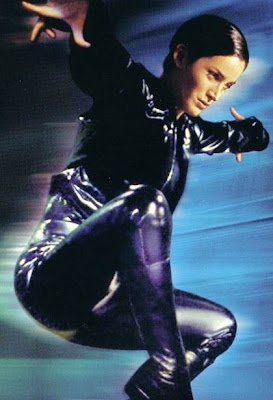
It got me thinking about female characters, specifically female leads. Here Jennifer Kesler talks about female leads in movies. Apparently, the consensus of opinion is that movie goers won't accept female lead characters, so the females end up as girlfriends and love interests. Kesler talks about Ripley from Alien and how no one had trouble taking her seriously. She reviews other lead females in successful movies and in flops like Ultraviolet, and comes to the conclusion that if females are dressed too sexily we (viewers) can't take them seriously.
In this post about female characters in movies Kelser talks about how her screen writing tutors taught her to write scripts the WOULDN'T pass this test. Apparently the test goes like this:
1) There are at least two named female characters, who
2) talk to each other about
3) something other than a ma.
I laughed aloud when I read this. She says:
'According to Hollywood, if two women came on screen and started talking, the target male audience’s brain would glaze over and assume the women were talking about nail polish or shoes or something that didn’t pertain to the story. Only if they heard the name of a man in the story would they tune back in. By having women talk to each other about something other than men, I was “losing the audience.”'
Unlike the film industry which believes that Women don't go to see movies, publishers know that women read books. You can see from the very big slice of action heroines in paranormal books that women are happy reading about female action characters who drive a story forward. These female characters are often weapons/martial arts experts who can take a man down in 3 seconds flat.
In her post, Writing Strong Women by fantasy author Glenda Larke. Glenda talks about the kind of women are aren't super heroes and don't know how to kick butt. She talks about women who have to be strong while being physically weaker. She says:
'... in the Stormlord trilogy, I wrote of an ordinary woman. She’s nothing much to look at. She’s seriously short-sighted in a society that hasn’t yet developed eye-glasses. For years, she’s been in love with a rogue who’s never given her a second glance. Her magic powers are weak, so she’s not much of a rainlord, either. She’s twenty-eight and unmarried.'
Will readers accept a character who is a mother, who also happens to lead a nation? We'll see when I send my new trilogy off to the publisher. Do you have a fave female lead character in film or books? Is she short sighted? If she takes off her glasses and lets her hair out of its bun do men fall off their chairs? LOL

It got me thinking about female characters, specifically female leads. Here Jennifer Kesler talks about female leads in movies. Apparently, the consensus of opinion is that movie goers won't accept female lead characters, so the females end up as girlfriends and love interests. Kesler talks about Ripley from Alien and how no one had trouble taking her seriously. She reviews other lead females in successful movies and in flops like Ultraviolet, and comes to the conclusion that if females are dressed too sexily we (viewers) can't take them seriously.
In this post about female characters in movies Kelser talks about how her screen writing tutors taught her to write scripts the WOULDN'T pass this test. Apparently the test goes like this:
1) There are at least two named female characters, who
2) talk to each other about
3) something other than a ma.
I laughed aloud when I read this. She says:
'According to Hollywood, if two women came on screen and started talking, the target male audience’s brain would glaze over and assume the women were talking about nail polish or shoes or something that didn’t pertain to the story. Only if they heard the name of a man in the story would they tune back in. By having women talk to each other about something other than men, I was “losing the audience.”'
Unlike the film industry which believes that Women don't go to see movies, publishers know that women read books. You can see from the very big slice of action heroines in paranormal books that women are happy reading about female action characters who drive a story forward. These female characters are often weapons/martial arts experts who can take a man down in 3 seconds flat.
In her post, Writing Strong Women by fantasy author Glenda Larke. Glenda talks about the kind of women are aren't super heroes and don't know how to kick butt. She talks about women who have to be strong while being physically weaker. She says:
'... in the Stormlord trilogy, I wrote of an ordinary woman. She’s nothing much to look at. She’s seriously short-sighted in a society that hasn’t yet developed eye-glasses. For years, she’s been in love with a rogue who’s never given her a second glance. Her magic powers are weak, so she’s not much of a rainlord, either. She’s twenty-eight and unmarried.'
Will readers accept a character who is a mother, who also happens to lead a nation? We'll see when I send my new trilogy off to the publisher. Do you have a fave female lead character in film or books? Is she short sighted? If she takes off her glasses and lets her hair out of its bun do men fall off their chairs? LOL
Subscribe to:
Posts (Atom)


 Posts
Posts

