

First, I want to start by bragging that I have talked to Terry Pratchett twice, outside the Discworldcon (where I got to talk to him a little more.) [The conversations themselves were by and large inconsequential – the second one dwelt on the habits of the felis domesticus and the advantages of an invisible fence.] I also want to admit that I read I Shall Wear Midnight, his latest book, just out.
What do these things have to do with one another?
In reading the last one in the saga of Tiffany Aching, I was reminded of the fact that witches don’t have the second sight. They have the first sight and the second thoughts.
I suspected the first time I came across that sentence that for witches you should read writers. Perhaps that’s just my personal deformation, of course. I can find myself reading a book on macrame and stop and view something as a profound image on writing technique.
That is neither here nor there. Whether Pratchett meant it as a metaphor for the writer or not, it reminded me also of the first time I saw him. It was World Fantasy or World Con (Yeah, I’m that sharp) in 2000 and it took place during the meet and greet (aka swill and mill – which leads me to believe it was WF as Worldcon is too big for such niceties.) There was this huge, garrulous crowd of people. And standing by the wall, looking out with intent eyes was... Terry Pratchett. It took me a moment to believe it was him. I’d been reading him for five years, and I didn’t realize he was JUST starting to take off in the US. (Heck, that same con, when asked for an example of a non-monarchic system in a fantasy I said “Terry Pratchett’s city-state ruled by Patricians and guilds” and the panelists said “Terry who?” Also, they booked his reading in one of the smallest rooms. There were people standing and sitting in every inch available. I was kneeling at the back, and someone was standing over me. I.e. He had fans, but the powers that be didn’t KNOW that.) Being me, and born, congenitally without shame, I then approached him, introduced myself and told him about the shrine to him in my office, next to the writing desk, and the goats I sacrificed daily to his picture, shame about the carpet. He took it in stride, and didn’t seem to think I was a total lunatic, at least considering he initiated a conversation with me later.
When I think of the first sight and the second thoughts, I think of him standing there, evaluating everyone, listening, trying to get inside people’s minds.
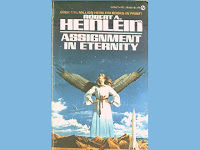
I’ve been listening to Heinlein, after reading his bio (And, heavens, the juvenile I’d never read: The Rolling Stones – could be my family talking. No, I’m serious. Scary that. Smaller cast of characters, same repartee) and I find that of course a lot of his experiences made it into the book. Dabs of this, bits of that, scenes recorded indelibly in the node of memory.
 We will do that, of course, all of us. How not? They are the things that make us, that compose the personality bit by bit, at the almost molecular level. More than that, we will use the feeling of being there. The fear before engaging in battle. The first time you realized someone was trying to kill you. The first time you faced the possibility someone might kill you but here you would stand and here you would face what might come. The fear from which courage is forged. And more than that – the pity you felt for the first time; the first time you fell in love; your first kiss.
All of these will come back to you when you write – when your character is in the same situation.
But what about the situations you’ve never faced? Above I described the first time you realized someone was trying to kill you. Yep, it’s an experience in my bank of memory (No, nothing paranoid. Someone was shooting at a crowd from an upper floor window. I was in the crowd. Not THAT exciting.) As is the experience of having a weapon pointed at me and choosing not to back down because backing down would have started a rout and increased the chances the weapon would be shot.
I have those experiences, but I realize they’re not common. And what if your character needs it? And what if my character needs experiences I’ve never had? Because characters do, from time to time. Dyce is divorced, with a son. Clearly I’ve never experienced that. Clearly I’ve never been a man, much less a young man who turns into a dragon. Clearly I’ve never faced a lion. And clearly my son has never been an alley cat addicted to beer.
Shouldn’t you write what you know? Of course you should. And the good writers, Pratchett and Heinlein come to mind, know humanity. They know how to untangle the skein of thread that binds us all. They know the truth beneath the passing situations. They have the first sight and the second thoughts.
Those are needed, see. The first sight reveals things as they are meant to appear. The second thoughts reveal things as they are.
Most writers – most of those slogging in the trenches, aspiring to greatness – can do this in varying degrees.
There are two “degrees” that annoy me to the point of rambling incoherence (Yes, like this.) One is the type where the writer chooses not to write anything he doesn’t “Know”. This is usually interpreted as anything he hasn’t lived through and it produces pathetic, over precious, involuted works of quotidian life. Very fine if that’s what you like. It is not my cup of tea. It is not even the foam on my cappuccino. Alternately, there are the people who interpret this as being “Write about what you’ve read about.” The problem is when they’re writing about a gender, an orientation, a class of people, a profession, a political assembly that they don’t belong to/despise/don’t care for, it tends to come across as second hand knowledge, about as flavorful and memorable as sawdust crackers. For examples refer to the vast sea of what I call pseudo redneck sf. You have the uneducated/laborer/artisan as a voice character, but the author never met anyone without three graduate degrees. So the character comes across as either stupid or sluggish or despicable or all three.
Are some people in those groups all three? Oh, undoubtedly. Though to be truly nefarious you need to sharpen those qualities through the application of exquisite education. Trust me. I’m one of them with graduate degrees and worse I run in their circles. But your average laborer is no more likely to be stupid than your average professor. For a given kind of stupidity, they might be less. Less bookish, sure. Less educated, sure. Simple? Moronic? No.
And this is where the first sight and the second thoughts come in handy. I’ve spent any amount of time lurking in public places – and not just university bars – listening to people. In fact, at any party, any diner, any restaurant, any public garden, any sports event, I divide in two. There’s the Sarah that takes part, and the Sarah that listens. And then... there’s the Sarah that thinks. “What would I be like if....”
Am I very good at this? Well, I’m neither Pratchett nor Heinlein, nor even Freer (who has a more varied life experience than most of us) but I try really hard. And if I fall short in how I handle someone, I hope I fail on the side of respect. I.e., I would rather treat my character who isn’t like me with more respect than disdain.
I’m not talking about villains here. We all know about rounding your villains. We’re talking about secondary or even main characters who are utterly different from you.
What would I like you to do? Identify a type/gender/profession of character you’ve never written. Tell me about it in the comments. Try to imagine what you would be like as that person, assuming you have the same intelligence and faculties, just a different starting point. Then go do some rudimentary research and try to write it.
Alternately and as well, feel free to rant about how this is often violated, just use no names or book titles, because I already have enough enemies; or to talk about someone who did this wonderfully. I’ve named my contenders above.
What do these things have to do with one another?
In reading the last one in the saga of Tiffany Aching, I was reminded of the fact that witches don’t have the second sight. They have the first sight and the second thoughts.
I suspected the first time I came across that sentence that for witches you should read writers. Perhaps that’s just my personal deformation, of course. I can find myself reading a book on macrame and stop and view something as a profound image on writing technique.
That is neither here nor there. Whether Pratchett meant it as a metaphor for the writer or not, it reminded me also of the first time I saw him. It was World Fantasy or World Con (Yeah, I’m that sharp) in 2000 and it took place during the meet and greet (aka swill and mill – which leads me to believe it was WF as Worldcon is too big for such niceties.) There was this huge, garrulous crowd of people. And standing by the wall, looking out with intent eyes was... Terry Pratchett. It took me a moment to believe it was him. I’d been reading him for five years, and I didn’t realize he was JUST starting to take off in the US. (Heck, that same con, when asked for an example of a non-monarchic system in a fantasy I said “Terry Pratchett’s city-state ruled by Patricians and guilds” and the panelists said “Terry who?” Also, they booked his reading in one of the smallest rooms. There were people standing and sitting in every inch available. I was kneeling at the back, and someone was standing over me. I.e. He had fans, but the powers that be didn’t KNOW that.) Being me, and born, congenitally without shame, I then approached him, introduced myself and told him about the shrine to him in my office, next to the writing desk, and the goats I sacrificed daily to his picture, shame about the carpet. He took it in stride, and didn’t seem to think I was a total lunatic, at least considering he initiated a conversation with me later.
When I think of the first sight and the second thoughts, I think of him standing there, evaluating everyone, listening, trying to get inside people’s minds.
I’ve been listening to Heinlein, after reading his bio (And, heavens, the juvenile I’d never read: The Rolling Stones – could be my family talking. No, I’m serious. Scary that. Smaller cast of characters, same repartee) and I find that of course a lot of his experiences made it into the book. Dabs of this, bits of that, scenes recorded indelibly in the node of memory.
We will do that, of course, all of us. How not? They are the things that make us, that compose the personality bit by bit, at the almost molecular level. More than that, we will use the feeling of being there. The fear before engaging in battle. The first time you realized someone was trying to kill you. The first time you faced the possibility someone might kill you but here you would stand and here you would face what might come. The fear from which courage is forged. And more than that – the pity you felt for the first time; the first time you fell in love; your first kiss.All of these will come back to you when you write – when your character is in the same situation.
But what about the situations you’ve never faced? Above I described the first time you realized someone was trying to kill you. Yep, it’s an experience in my bank of memory (No, nothing paranoid. Someone was shooting at a crowd from an upper floor window. I was in the crowd. Not THAT exciting.) As is the experience of having a weapon pointed at me and choosing not to back down because backing down would have started a rout and increased the chances the weapon would be shot.
I have those experiences, but I realize they’re not common. And what if your character needs it? And what if my character needs experiences I’ve never had? Because characters do, from time to time. Dyce is divorced, with a son. Clearly I’ve never experienced that. Clearly I’ve never been a man, much less a young man who turns into a dragon. Clearly I’ve never faced a lion. And clearly my son has never been an alley cat addicted to beer.
Shouldn’t you write what you know? Of course you should. And the good writers, Pratchett and Heinlein come to mind, know humanity. They know how to untangle the skein of thread that binds us all. They know the truth beneath the passing situations. They have the first sight and the second thoughts.
Those are needed, see. The first sight reveals things as they are meant to appear. The second thoughts reveal things as they are.
Most writers – most of those slogging in the trenches, aspiring to greatness – can do this in varying degrees.
There are two “degrees” that annoy me to the point of rambling incoherence (Yes, like this.) One is the type where the writer chooses not to write anything he doesn’t “Know”. This is usually interpreted as anything he hasn’t lived through and it produces pathetic, over precious, involuted works of quotidian life. Very fine if that’s what you like. It is not my cup of tea. It is not even the foam on my cappuccino. Alternately, there are the people who interpret this as being “Write about what you’ve read about.” The problem is when they’re writing about a gender, an orientation, a class of people, a profession, a political assembly that they don’t belong to/despise/don’t care for, it tends to come across as second hand knowledge, about as flavorful and memorable as sawdust crackers. For examples refer to the vast sea of what I call pseudo redneck sf. You have the uneducated/laborer/artisan as a voice character, but the author never met anyone without three graduate degrees. So the character comes across as either stupid or sluggish or despicable or all three.
Are some people in those groups all three? Oh, undoubtedly. Though to be truly nefarious you need to sharpen those qualities through the application of exquisite education. Trust me. I’m one of them with graduate degrees and worse I run in their circles. But your average laborer is no more likely to be stupid than your average professor. For a given kind of stupidity, they might be less. Less bookish, sure. Less educated, sure. Simple? Moronic? No.
And this is where the first sight and the second thoughts come in handy. I’ve spent any amount of time lurking in public places – and not just university bars – listening to people. In fact, at any party, any diner, any restaurant, any public garden, any sports event, I divide in two. There’s the Sarah that takes part, and the Sarah that listens. And then... there’s the Sarah that thinks. “What would I be like if....”
Am I very good at this? Well, I’m neither Pratchett nor Heinlein, nor even Freer (who has a more varied life experience than most of us) but I try really hard. And if I fall short in how I handle someone, I hope I fail on the side of respect. I.e., I would rather treat my character who isn’t like me with more respect than disdain.
I’m not talking about villains here. We all know about rounding your villains. We’re talking about secondary or even main characters who are utterly different from you.
What would I like you to do? Identify a type/gender/profession of character you’ve never written. Tell me about it in the comments. Try to imagine what you would be like as that person, assuming you have the same intelligence and faculties, just a different starting point. Then go do some rudimentary research and try to write it.
Alternately and as well, feel free to rant about how this is often violated, just use no names or book titles, because I already have enough enemies; or to talk about someone who did this wonderfully. I’ve named my contenders above.


 Posts
Posts

